
Why the Cage Process Matters: Building Chain of Custody in a Coin Dealership
LEDGER · August 4, 2026
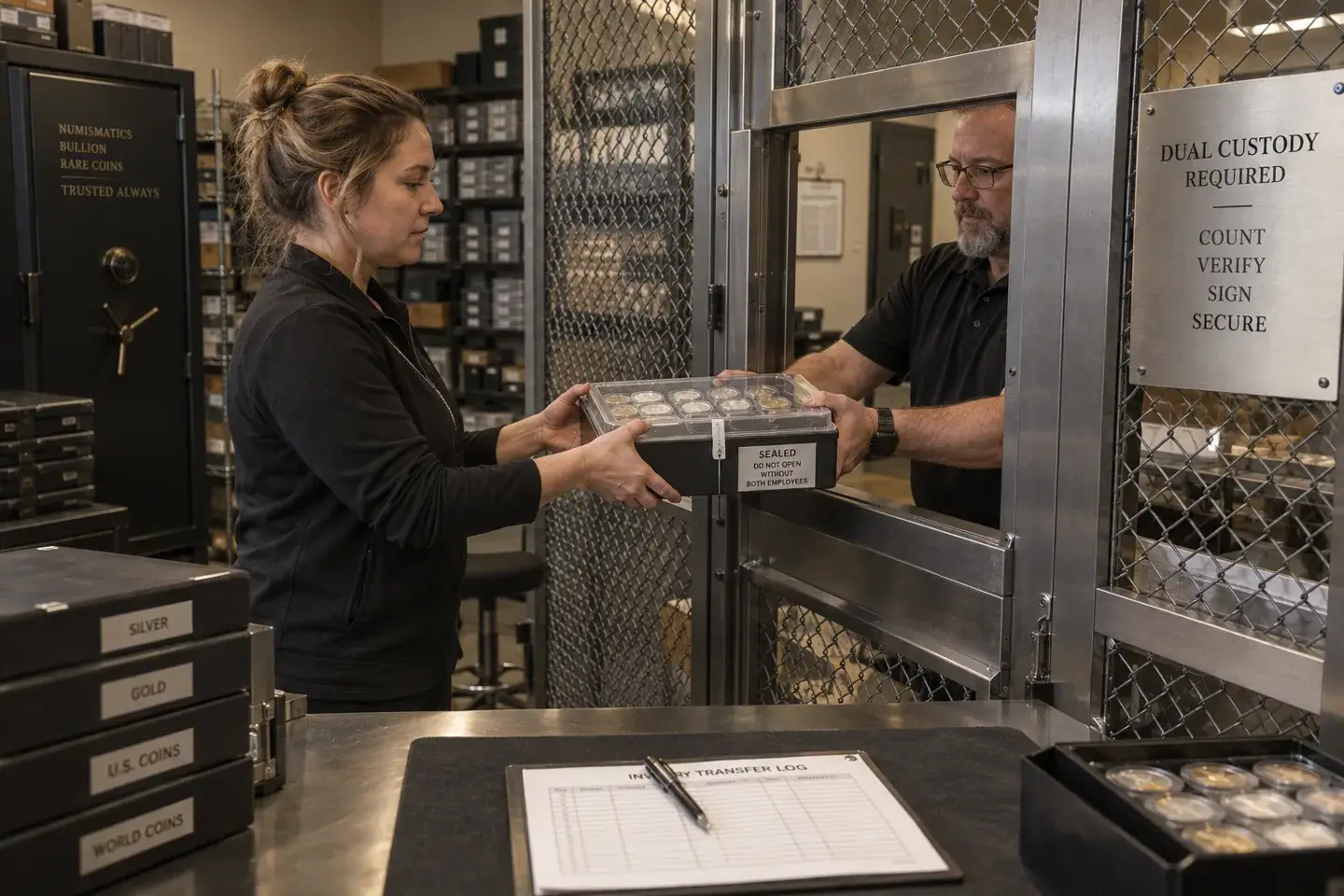
That interval is where many preventable losses begin.
A purchased lot may be placed on a counter “for a moment” and then moved without a record. An expected quantity may not match what reaches the back office. A tube may be counted but not weighed. A high-value item may leave secure storage without a second approval. A discrepancy may be discussed verbally and then forgotten. Weeks later, the accounting system still shows the purchase, but no one can give a confident answer about the lot’s current location, condition, or disposition.
The answer is a Cage process: a controlled chain-of-custody workflow layered on top of the financial inventory ledger. bullionOS includes Cage Operations because precious-metals inventory needs both kinds of truth. The inventory ledger explains the accounting quantity and transaction effect. The Cage explains where the acquired material is, who verified it, why it moved, and whether an exception or approval was involved.
What “the Cage” means in a modern dealership
The Cage does not have to be a literal wire enclosure. It is the controlled operational boundary around newly acquired or otherwise sensitive inventory. Depending on the dealership, the physical environment may include a receiving station, back-room safe, vault, locked cabinet, grading preparation area, melt container, wholesale staging shelf, or a combination of locations.
The process matters more than the architecture. Material enters custody through a defined receiving step. Expected details are compared with observed details. The person handling the item and the location are recorded. Movement to a new location or destination is purposeful. Release is approved at the appropriate level. Exceptions remain visible until resolved.
In bullionOS, the Cage is designed as a custody overlay rather than a replacement for inventory accounting. That distinction prevents a common design mistake. Financial quantity answers “What did the business acquire or sell?” Custody data answers “Where is the material and what happened to it?” Combining those questions in one editable count can create ambiguity. Linking two purpose-built records produces a stronger answer.
The vulnerable gap after a purchase
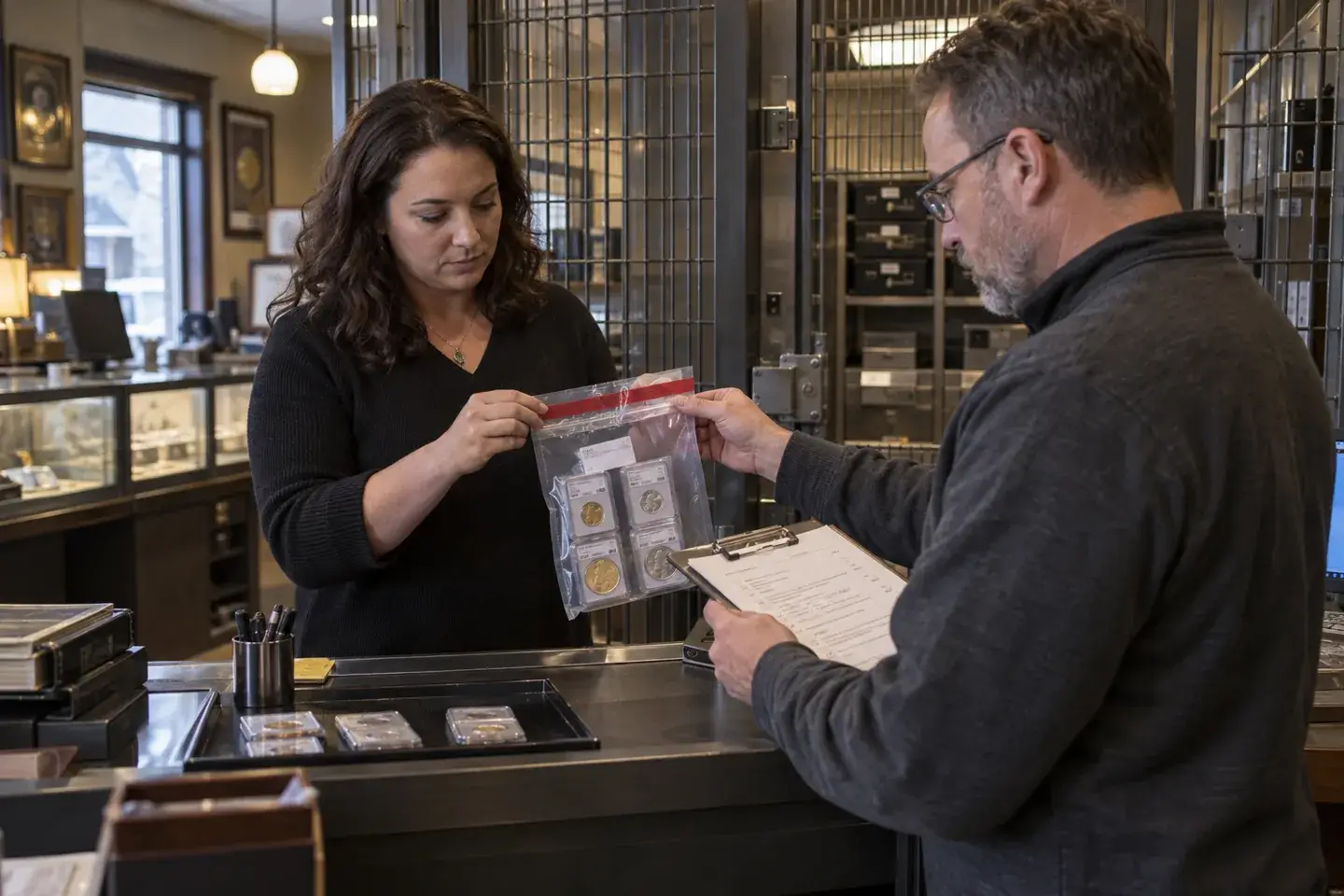
Why is the post-purchase interval so important? Because several operational conditions change at once:
- The client has transferred material to the dealership.
- The dealership has committed cash or another form of payment.
- The acquired material may not yet have a permanent location.
- A preliminary description may still require secondary verification.
- The eventual exit path—retail, wholesale, melt, grading, hold, or return—may be undecided.
- Several employees may touch the lot before it reaches stable storage.
If the transaction is recorded but physical receiving is informal, the business gains a balance-sheet asset without gaining reliable control of the object. That is especially risky when a single invoice contains many line items, mixed metals, or products with different destinations.
bullionOS can branch completed purchase lines into a Cage receiving queue. Each line can carry the expected product identity, quantity, weight, purity, purchase cost, spot value at intake, and invoice reference. The financial transaction becomes the source of the receiving expectation; staff do not have to type the purchase again into a separate log.
This removes a dangerous gap between “the system says we bought it” and “someone in the back knows where it went.”
Step 1: Queue every eligible purchase consistently
A custody process fails if employees must remember when to start it. The safest workflow begins automatically from the business event that creates the custody obligation.
For bullionOS, that event is the relevant completed state of a buy-side invoice. Eligible invoice lines enter the Cage queue once, preserving the connection to the original invoice and client transaction. This helps the receiving team see what is expected without hunting through paperwork or waiting for a handoff message.
Consistency has three benefits. First, no employee has to decide whether a purchase is “important enough” to track. Second, the queue itself becomes a control total: completed purchases should have corresponding receiving work unless the business has deliberately disabled or bypassed the Cage under its configuration. Third, duplicate queuing is prevented by the relationship between the invoice line and its Cage item.
A dealer may choose a cutover date when introducing the process so that new activity is controlled without pretending that every historical invoice went through a workflow that did not yet exist. That is a healthier audit posture than backfilling artificial custody events.
Step 2: Begin an accountable receiving session
Receiving should make clear who took responsibility and when. bullionOS allows the operator to start a Cage receipt at the invoice level, moving eligible lines from awaiting receipt into verification and recording the check-in actor and time.
This is more than an administrative timestamp. It marks the transition from a shared queue to accountable work. If several purchases are waiting, managers can distinguish untouched receipts from those actively being verified. If a receipt stalls, the assigned context is available. If a later question arises, the dealership can identify the start of custody review.
The process should also fit the physical environment. A receiving screen used at a counter or secure station must be touch-friendly, searchable, and fast. Staff should not be forced to carry a handwritten tally to a distant desktop and enter it later. Delayed entry weakens the evidentiary value of the record because memory and physical state can change between the event and the documentation.
Step 3: Verify quantity, weight, purity, and location
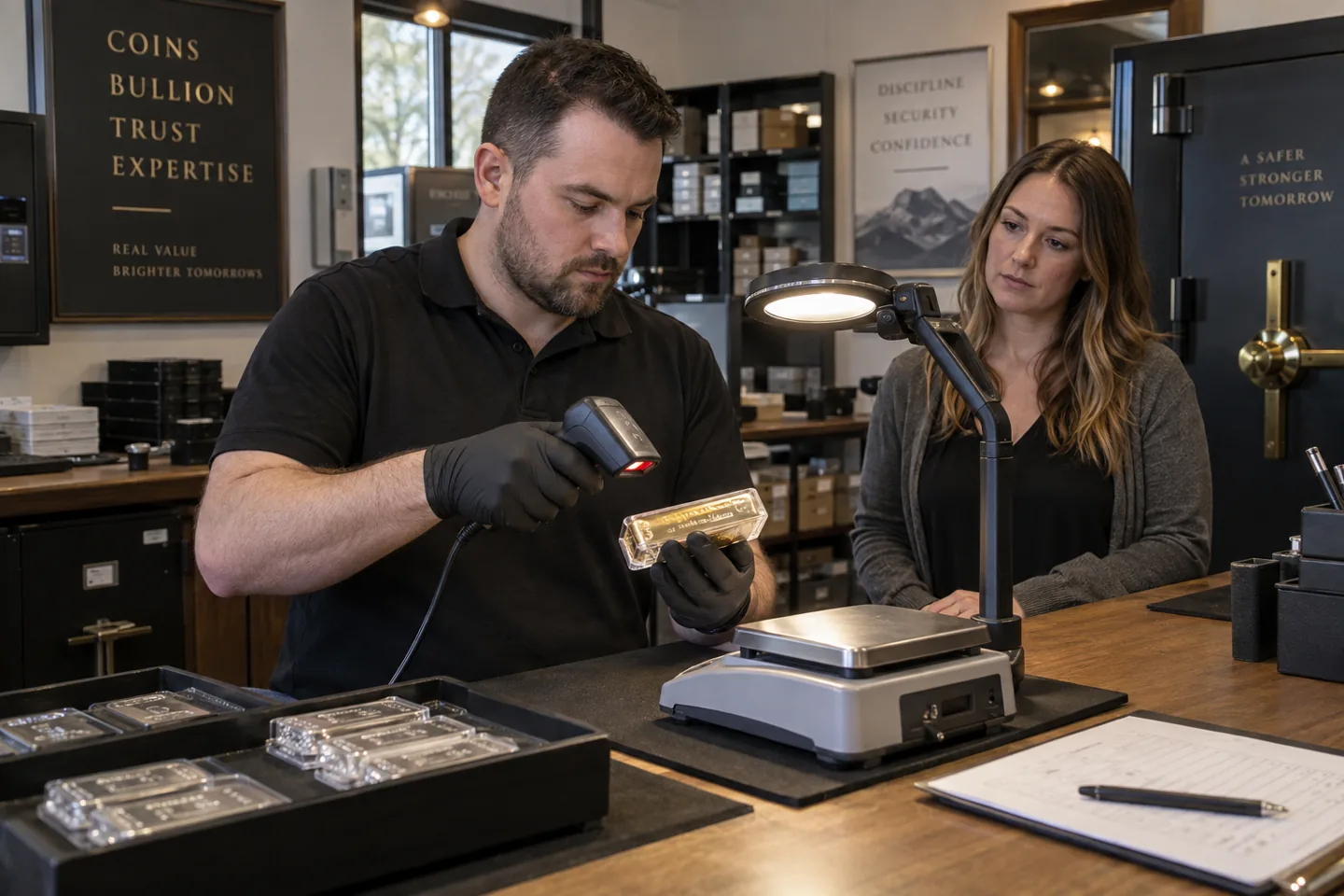
Verification converts expectation into observed fact. The operator compares the purchased line with the material actually received into controlled storage. Depending on the item, the review can include:
- Actual quantity versus expected quantity
- Actual gross or troy weight versus expected weight
- Purity or metal identity where appropriate
- Product identity and distinguishing notes
- Condition or packaging observations
- The location where the material is being placed
- The intended disposition or next operational path
bullionOS retains both expected and verified values. That is critical. Overwriting the expected quantity with the observed quantity would erase the discrepancy. A good custody record shows the comparison, the person who performed it, and the time it occurred.
Tolerance settings can reflect the dealership’s operating policy. Quantity variance may require an exact match, while weight may allow a small defined tolerance for measurement realities. The software should not decide what tolerance is appropriate for every dealer; it should apply the controls authorized by the business.
Location is equally important. “In the vault” may be insufficient when the vault contains shelves, bins, trays, client holds, and outbound lots. A consistent location convention—such as vault, cabinet, shelf, and bin—makes retrieval faster and reduces unnecessary handling. bullionOS surfaces missing locations as an operational exception for items that should be controlled.
Step 4: Turn discrepancies into managed exceptions
Every dealership eventually encounters a mismatch. The goal is not to eliminate the possibility; it is to prevent the mismatch from disappearing into an informal conversation.
If observed quantity or weight exceeds the configured tolerance, bullionOS can require an approval before verification is accepted. The item can be placed into an exception state with a code and note. The approval request identifies the affected record, the reason, the requester, and the eventual decision.
This gives managers a structured decision point. Perhaps a line was entered incorrectly at the counter. Perhaps the physical lot was separated during intake. Perhaps packaging weight was included in one measurement but not another. Perhaps the product mapping is wrong. Whatever the cause, resolution should happen with the evidence still available.
An exception workflow should answer:
- What was expected?
- What was observed?
- How large is the difference?
- Who performed the verification?
- What evidence or note supports the observation?
- Who approved the resolution, if approval was required?
- What correction or disposition followed?
Once captured, exception data can reveal patterns. Repeated mismatches on a particular product might point to catalog specifications. Repeated problems at a particular stage may indicate a training need. A recurring variance around packaging may justify a revised measurement standard. Without structured records, each discrepancy feels isolated. With records, the dealership can improve the process.
Step 5: Record movement, not just the current location
A current location tells where an item is now. A movement history explains how it got there. Both matter.
bullionOS supports Cage movements such as queueing, verification, cage-in, relocation, request-out, cage-out, return, exception, resolution, and adjustment. A movement can record the prior location, new location, destination, quantity, reason, actor, approving user, override reason, and relevant metadata.
This history protects the dealership when material changes hands internally. Consider a high-value coin that moves from receiving to the main vault, then to photography, then to a client hold, and finally back to the vault. A single editable “location” field would show only the last value. The movement ledger shows the route and the people involved.
Movement history also encourages better behavior. When staff know that transfers have a defined record, handoffs become explicit. The process replaces “I think Alex moved it” with a timestamped event. That is valuable during ordinary retrieval, internal reconciliation, insurance documentation, and incident review.
Step 6: Control cage-out and dual approval
The moment material leaves secure custody deserves particular attention. A Cage-out request can lead to a retail case, wholesale shipment, melt processor, grading service, client return, or another destination. Each path changes the risk profile.
bullionOS allows a release to begin as a request rather than an immediate, invisible location edit. The request can specify destination and reason. Business controls can require a second approval when the value crosses a defined threshold. This is often called dual control: the employee requesting a sensitive action is not the only person authorizing it.
Dual control does not imply distrust of staff. It protects staff as well as the business. Two-person verification reduces accidental releases, creates a clearer handoff, and avoids placing the entire burden of a high-value decision on one employee. It also provides evidence that the dealership followed its own policy.
Thresholds should be deliberate. Requiring two approvals for every low-value movement can create fatigue and encourage workarounds. Requiring no approval for significant releases creates unnecessary exposure. bullionOS gives the dealership a configurable control point so policy can match its scale and risk tolerance.
If an override is permitted, the reason should be preserved. An override without explanation is simply a missing control. An override with role restriction, reason capture, and audit history is an exception that management can review.
Disposition turns storage into a decision
Securely holding material is necessary, but inventory should not remain in the Cage without a plan. Newly acquired items tie up working capital and carry metal-price and marketability exposure. The dealership needs to decide how each lot should create value.
bullionOS can associate a Cage item with a disposition such as review, retail, wholesale, melt, grading, hold, or return. It can also carry due dates, purchase cost, spot value at intake, and a target exit value. These fields help transform the Cage from a passive storage list into an operating queue.
For example:
- A common bullion product may move quickly to retail availability.
- A dealer lot may be prepared for wholesale bids.
- Scrap may be directed to a refiner or melt workflow.
- A collectible coin may be held for research or sent for grading.
- A questionable item may remain on hold pending expert review.
- A transaction issue may require return to the client through an approved process.
Aging indicators make delay visible. If material has remained in controlled inventory beyond a warning or critical period, management can review why. Aging does not always mean failure; a strategic hold may be intentional. The key is that the reason and responsibility should be visible rather than assumed.
The audit trail is part of the control
A chain of custody is credible only if its history is durable. bullionOS records both human and system actions around the Cage, including configuration changes, receipt starts, verification, movement, approvals, exceptions, and releases. Actors and timestamps allow the dealership to reconstruct events without depending on recollection.
Audit history should be immutable in the practical sense: prior events are preserved, and corrections create new events rather than rewriting the past. This is especially important when a business changes its workflow. For example, bullionOS allows an authorized owner or administrator to disable the Cage process globally. When disabled, future eligible purchase transitions can be recorded as bypassed instead of generating new Cage rows. Existing custody records, movements, evidence, approvals, and exceptions remain intact. Re-enabling applies to future transactions and does not fabricate backfilled history.
That behavior reflects a sound governance principle. Configuration can change prospectively, but history should still describe what actually happened under the prior configuration.
What the Cage process prevents
No control can prevent every loss, but a well-run Cage process materially reduces several common risks:
Unverified intake
The invoice description is not treated as final proof of the received material. Expected and observed values remain distinct.
Orphaned purchases
Completed purchase lines appear in a receiving queue instead of relying on someone to create a separate custody entry.
Unexplained movement
Relocations and releases have actors, locations, destinations, and reasons rather than appearing as silent edits.
Hidden discrepancies
Variances become exceptions with notes and, when required, approvals.
Weak high-value release controls
Threshold-based dual control can separate request from approval.
Aging without ownership
Warning and critical aging indicators surface lots that require a disposition decision.
Destructive cleanup
Historical custody events remain available even when a workflow is disabled or an item reaches a closed state.
Together, these controls replace a fragile sequence of human reminders with a shared, reviewable process.
A practical Cage operating routine
A dealer introducing a Cage process can begin with a straightforward routine:
Receive
Open the purchase receipt from the queue. Confirm the invoice and client context. Accept responsibility for the receiving session.
Verify
Count and measure the material using the dealership’s approved equipment and standards. Compare observed values with the purchase record. Add condition notes or supporting evidence when appropriate.
Locate
Assign a specific secure location using a consistent naming convention. Avoid free-form shortcuts that only one employee understands.
Classify
Choose a disposition and due date. Separate routine retail items from material requiring wholesale bids, grading, melt, return, or further review.
Escalate
When a variance exceeds policy, stop the normal flow. Preserve the material and evidence, create the exception, and obtain approval before proceeding.
Move
Record every meaningful relocation and handoff. Do not update only the final location.
Release
Create a cage-out request with the destination and reason. Obtain secondary approval above the configured value threshold. Complete the handoff and movement record.
Review
At opening and closing, review awaiting receipts, active verification, exceptions, missing locations, out requests, and aging inventory. Assign every unresolved item to a person.
This routine is simple enough to train and strong enough to scale. As the dealership grows, the same records can support exception analysis, management dashboards, wholesale decisions, and formal procedures.
Custody is an operating advantage
Dealers sometimes view chain of custody as pure overhead—a set of steps that slows down the movement of inventory. Poorly designed controls can do that. A useful Cage process does the opposite. It reduces time spent searching, reconstructing handoffs, debating old discrepancies, and asking which lot was intended for which destination.
Clear custody also improves capital decisions. Owners can see value held in the Cage, items awaiting verification, lots with exceptions, material missing a location, and inventory aging beyond policy. Operations staff know which receipts require work. Managers know which actions need approval. Employees have a record that supports the handoffs they performed correctly.
For clients, the process may remain largely invisible, but its effects are tangible: a more organized appointment, fewer fulfillment errors, better answers, and a dealership that treats entrusted property with care.
Build the record while the material moves
The strongest chain of custody is created at the same time as the physical event. It is not reconstructed at the end of the week. bullionOS connects the purchase invoice to receiving, verification, location, movement, exception, approval, disposition, and release so the digital record follows the material through the dealership.
That connection is the heart of the Cage process. It recognizes that a precious-metals purchase is not complete merely because money changed hands. The dealership must be able to demonstrate what it received, who checked it, where it was placed, why it moved, and how it left controlled custody.
Want to see how a Cage workflow can fit your dealership’s receiving and vault procedures? Request a private bullionOS walkthrough at bullionos.co.