
Estate Coin Collection Workflow: From First Call to Final Settlement
LEDGER · August 23, 2026

The family needs a process before it needs a price
The person calling a coin shop after a death may not know what the collection contains, how it was organized, who has authority, or whether the family wants an appraisal, sale, division, or simple education. Beginning with a purchase number can create pressure and misunderstand the assignment. Begin by defining the service, decision-makers, property location, time constraints, and next safe step.
Estate work is not one transaction type. It may involve an executor selling assets, a trustee managing property, heirs seeking an equitable division, a surviving spouse asking for orientation, an attorney or fiduciary requesting documentation, or a family that only wants secure transport and an inventory. Each situation can require different authority and deliverables.
Create a case record at the first substantive contact. Record factual information, the caller’s stated role, known parties, preferred communication method, location, general scope, and the purpose they describe. Mark assertions as unverified until supporting authority is reviewed. One case record should later connect appointments, containers, images, item groups, evaluations, proposals, approvals, custody, payments, and final documents.
Structure the first call
Use a short, compassionate intake rather than an interrogation. Ask whether there is immediate security risk, where the property is, whether anyone has already moved or distributed it, and whether the caller has an inventory. Learn the approximate form of the collection—albums, certified coins, loose coins, bullion, jewelry, currency, safe-deposit contents, or mixed household material—without asking the caller to disclose unnecessary value details over an insecure channel.
Clarify the requested outcome. An insurance or tax appraisal is not the same as a purchase offer, and a rough orientation is not a formal valuation. Explain which services the shop provides, whether fees apply, what a purchase proposal includes, and when an independent credentialed appraiser, attorney, accountant, auction specialist, or other professional may be appropriate.
Finish with a specific next action: secure consultation, authority-document review, in-shop appointment, on-site assessment, transport plan, or referral. Send a concise recap with the contact person and preparation guidance. Avoid telling the family to clean coins, break sealed packaging, reorganize albums, or carry an unknown high-value collection into a public lobby without a plan.
Verify authority before accepting instructions
Identity and authority are separate. Confirm the person present according to the shop’s policy, then determine who may deliver property, request an evaluation, approve a sale, receive information, and direct payment. Titles and documents differ by jurisdiction and estate structure. Staff should not provide legal interpretations beyond training; uncertain or conflicting authority is a stop condition for qualified review.
Record the represented estate, trust, or owner; the person acting; their stated capacity; the documents examined; the date and reviewer; any co-representative or limitation; and the approved payee or account instruction. If several family members attend, do not assume participation equals legal authority. Define one communication lead while preserving the rights and approvals required by applicable documents and law.
Authority can change. Court appointments may be pending, a successor trustee may become active, or counsel may issue new direction. Version the record and require reverification before material actions if the case pauses. Never let a warm family relationship substitute for a defensible instruction chain.
Estate, trust, probate, appraisal, tax, reporting, and property rules vary. This workflow is operational guidance, not legal, tax, fiduciary, or valuation advice. Have qualified professionals define the requirements for the specific engagement.
Define scope and deliverables in writing
Before taking custody or beginning a substantial evaluation, state what the shop will do. Identify the property or containers in scope, location, service type, valuation basis, effective date if relevant, fees, expected timing, transport responsibility, testing permissions, insurance assumptions, communication parties, and final deliverable. State what is outside scope.
If the shop is making a purchase offer, explain that an offer reflects the dealer’s intended resale or processing path and is not automatically an independent appraisal. If the family requests fair-market, replacement, tax, or division values, determine whether the shop is qualified and engaged to provide that work. Keep the service and purchase decisions distinct enough that the representative understands each one.
Define how additions will be handled. Estate material often appears in another drawer after intake. New property should receive a documented addendum or new batch, not merge invisibly into a signed inventory. Likewise, property removed by the representative should be signed out with identifiers and time.
Plan transport and the work environment
Choose between in-shop and on-site work based on collection size, security, privacy, accessibility, equipment, time, and custody risk. A large collection may be safer to assess in place before movement. A controlled shop station may be better for testing and detailed evaluation. Use insured, authorized transport practices that match the business’s policy and professional advice.
For an on-site visit, record staff attending, arrival and departure, rooms or containers reviewed, property removed, property left, seals used, and signatures required. Avoid working alone in an uncontrolled high-value environment where practical. Do not discuss routes, values, or schedules with unnecessary parties. For in-shop intake, use a private camera-covered area and reserve enough secure staging capacity before the collection arrives.
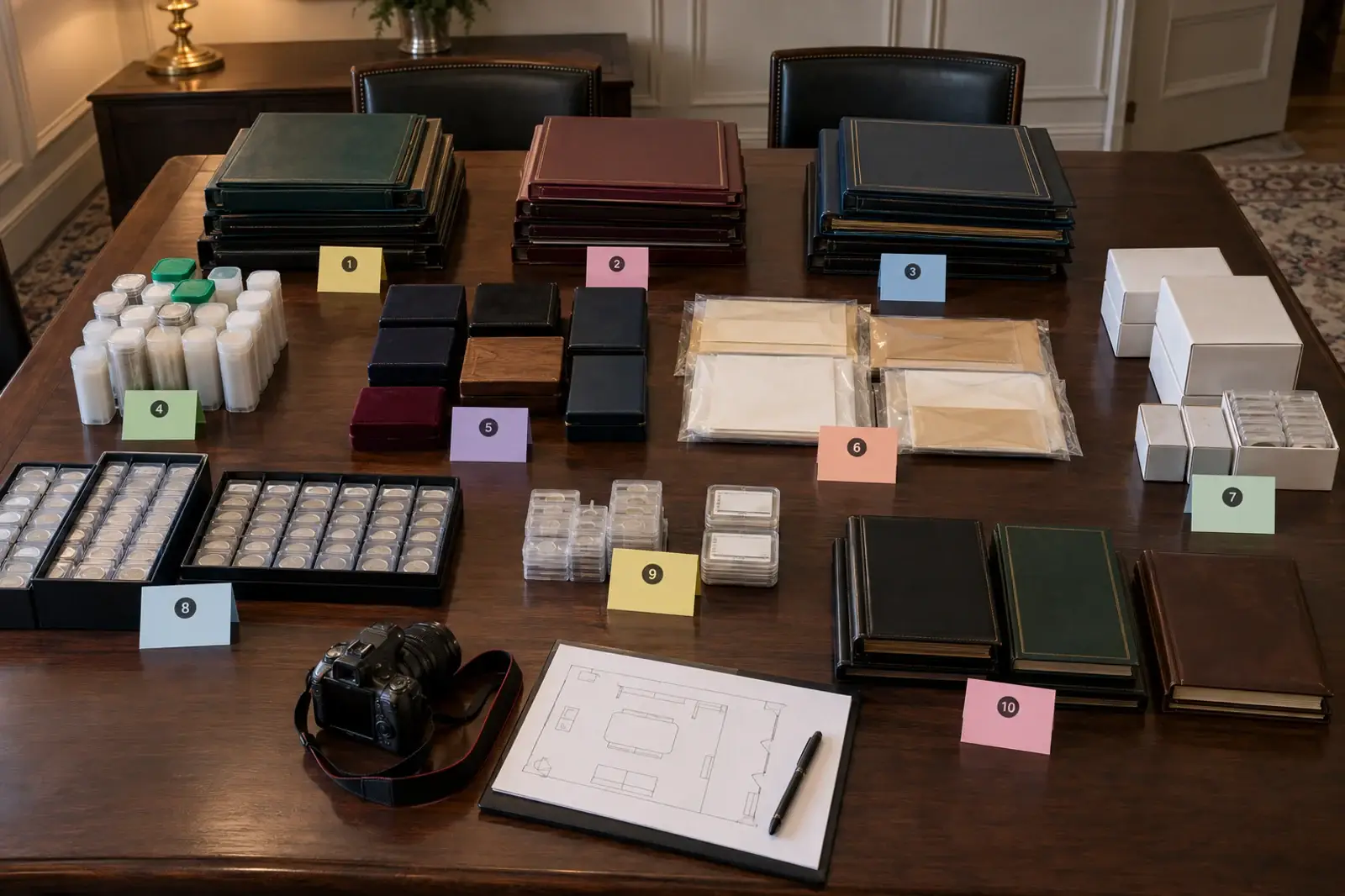
Create a container plan. Number boxes, bags, albums, cases, and trays before detailed sorting. Use tamper-evident seals where appropriate and record seal numbers. The container hierarchy lets the team pause and resume without losing provenance. It also gives the representative a comprehensible structure while item-level work is underway.
Preserve the collection before sorting it
Photograph the collection as presented: closed containers, album pages, labels, envelopes, certificates, notes, receipts, and meaningful groupings. These materials may contain provenance or the collector’s organization. Record the representative’s descriptions as statements, not verified conclusions. Do not discard packaging or paperwork merely because it appears ordinary.
Open a chain-of-custody batch for every controlled container. Record sender, receiver, time, condition, seal, and secure location. When staff break a batch into groups or items, maintain the parent-child link. An individual coin should remain traceable to its tray, box, and estate case even after several employees have handled it.
Use status labels that reflect reality: received sealed, inventory in progress, awaiting specialist, testing authorized, proposal pending, approved for sale, return to representative, purchased, paid, or closed. Property belonging to the estate must remain distinguishable from shop-owned inventory until a completed, authorized transaction transfers ownership.
Triage without losing important pieces
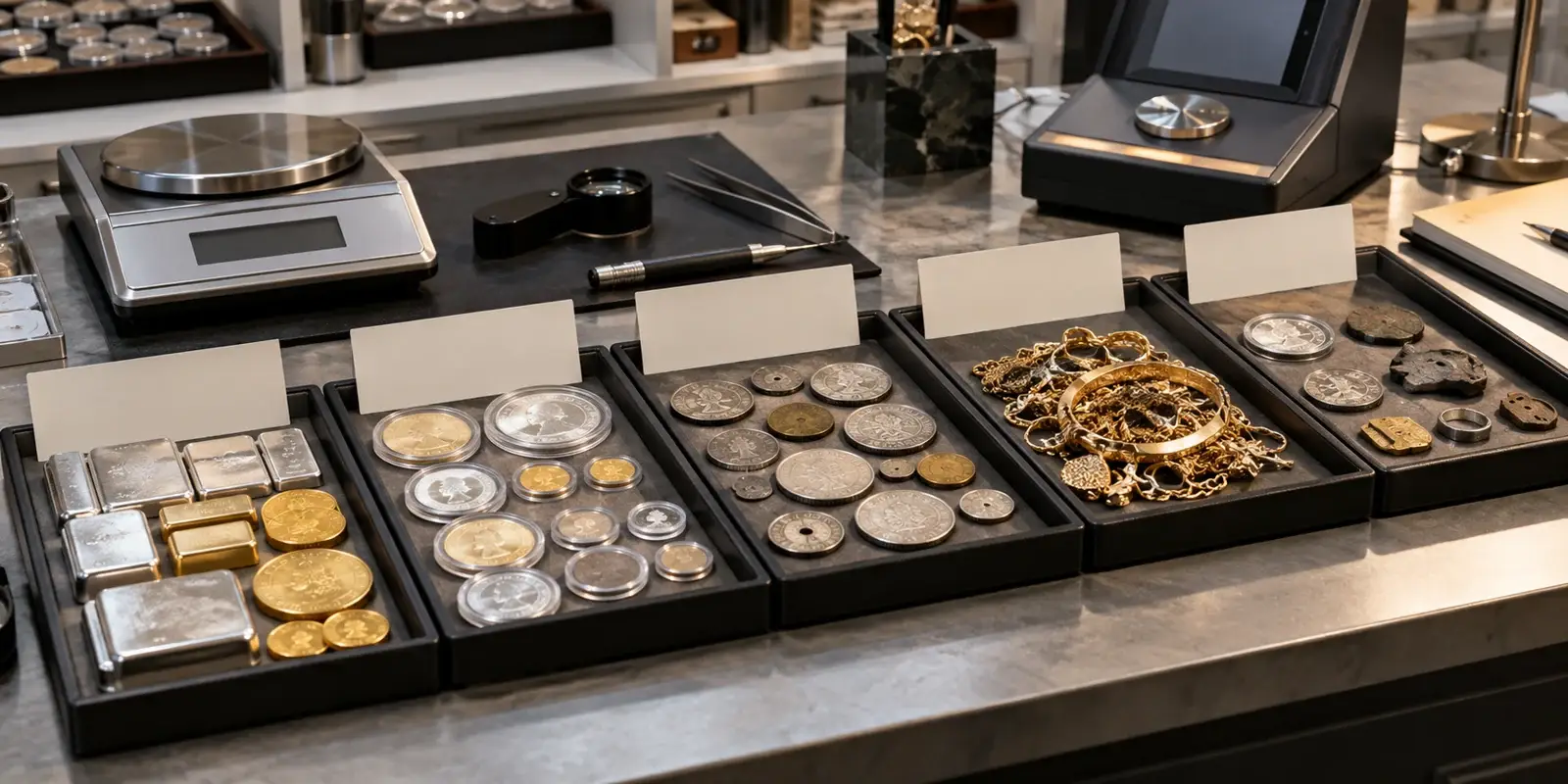
Triage creates work queues; it should not silently assign final value. Separate obvious common circulation, bullion, certified pieces, albums, likely numismatic items, jewelry or scrap, currency, foreign material, tokens and medals, paperwork, and items requiring specialist attention. Mark uncertain items rather than forcing a category.
Use sampling only under a documented method and where the category supports it. A homogeneous tube may permit a different approach from an album, mixed bag, or old envelope. High-value candidates, serial-numbered bars, sealed products, and distinctive pieces generally deserve item-level control. Set thresholds for photographs, individual weights, and second review.
Protect against anchoring. The collector’s handwritten value, an old receipt, or an online listing may be relevant evidence but is not automatically the current result. Preserve it, identify its date and basis, and complete the shop’s own examination. If staff discover an item materially different from the initial impression, update the category with a reason and reviewer.
Build a reproducible evaluation
For each controlled unit, record the fields necessary for the assignment: description, quantity, metal, weight or denomination, date and mint where relevant, grade or condition basis, certification, serial, test method, photos, reference sources, and notes. Use trained specialists for categories outside the shop’s competence. Preserve uncertainty instead of converting it into false precision.
Separate identification, authenticity, grade or condition, reference value, and proposed transaction value. They are related decisions, not one field. A genuine coin may have uncertain grade. A certified coin may still need holder verification. A metal item may test consistently but have a resale path that changes the offer. The record should show which conclusion rests on which evidence.
Apply a review threshold based on value, rarity, disagreement, or unusual condition. A second evaluator should be able to see the first person’s evidence while forming an independent conclusion where independence matters. Record reconciled differences. Do not overwrite the earlier opinion until the history disappears.
Choose the right sale channel item by item
A collection may deserve several outcomes: direct dealer purchase, wholesale placement, auction referral, consignment, refining, return to the family, or additional certification. Explain estimated timing, costs, risks, and net proceeds for material alternatives without guaranteeing a future result. A single blended offer can be convenient, but the representative should understand its scope and major value drivers.
Group common items where that makes the proposal readable, while breaking out pieces that materially affect the total. Identify excluded items. State how market-sensitive components are priced and when the proposal expires. If spot moves, issue a new version rather than changing the accepted document.
A dealer should not claim independence while financially interested in the purchase unless the role and conflict are appropriately disclosed and managed. In complicated or contested estates, recommend independent professional advice. Long-term trust is worth more than forcing every item through the shop’s preferred channel.
Present a decision package
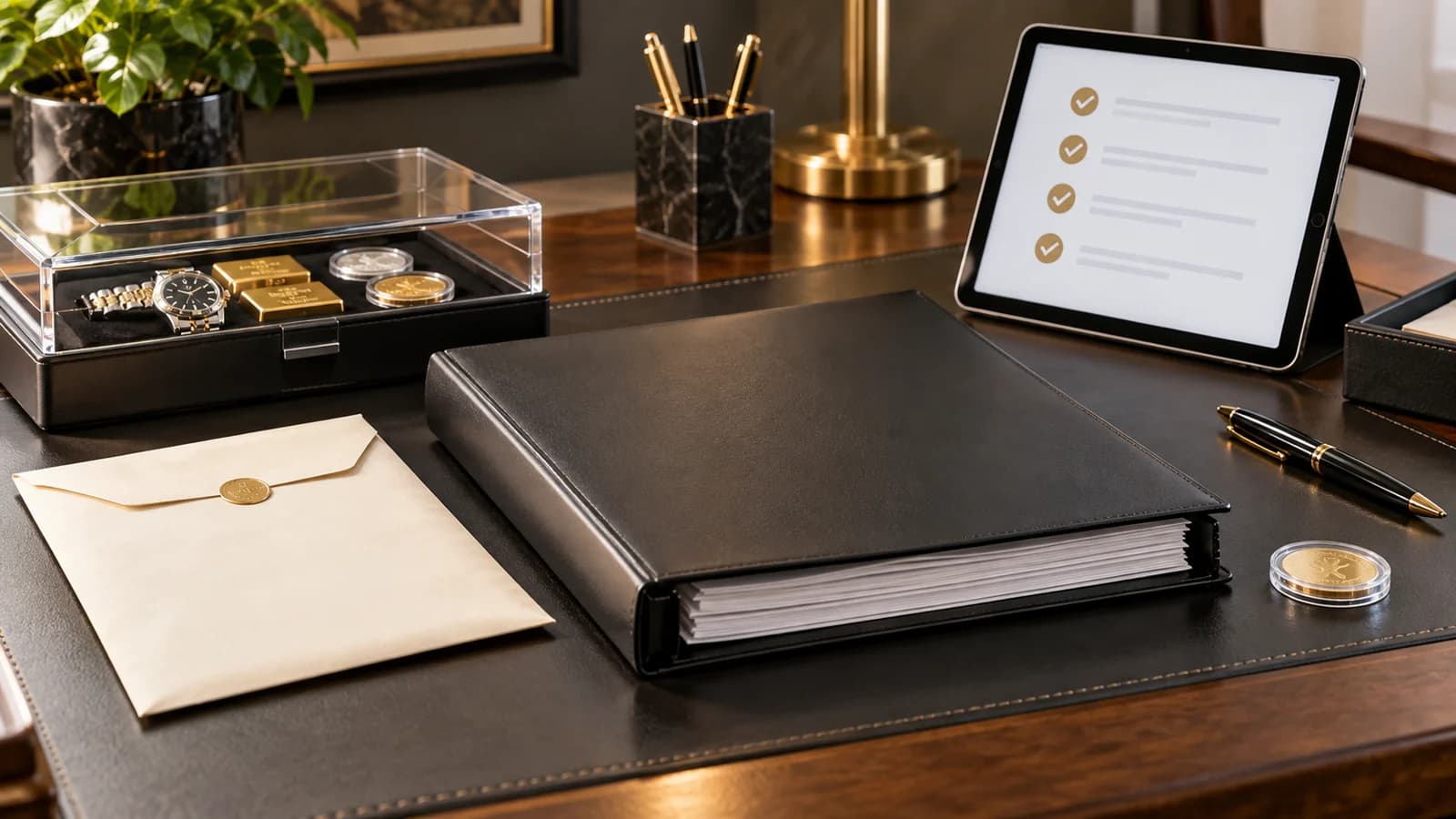
The representative should receive a structured summary: case and scope, containers or groups reviewed, methods and assumptions, material items, proposal or valuation by category, exclusions, unresolved questions, options, deadlines, fees, and next steps. Attach detailed schedules in a readable format. Use secure delivery appropriate to the sensitivity of the information.
Hold a review meeting for substantial collections. Walk through the categories and allow time for questions. Record who attended, which version was reviewed, decisions made, and items held back. If the representative needs family, attorney, or fiduciary approval, move the case to a waiting state with the next permitted contact date.
Approval should identify the authorized person, exact property, price or method, payment direction, items to return, and any conditions. Material changes require a revised version and renewed approval. A text saying “looks good” should not stand alone when the case demands formal authority and a detailed schedule.
Settle metal, money, and records together
At settlement, reconcile what entered custody, what the shop purchased, what went to another channel, what the representative removed, and what remains. Every controlled container and item group needs a final status and location. Confirm that ownership transfer and any applicable hold requirements are reflected before material becomes sellable inventory.
Payment should follow the approved payee and instructions. Require verification for changes and document check, wire, or other method according to policy. Keep proposed, approved, issued, delivered, cleared, failed, voided, and replaced states distinct. Do not erase a failed payment; link the correction.
Deliver the agreed records and receipt. List property returned and obtain acknowledgment. Close open tasks, revoke temporary access, and apply the retention schedule to identification, authority documents, images, evaluations, communications, and payment evidence. Ask whether the representative wants a later service follow-up; do not assume an estate engagement creates permanent marketing consent.
Manage the case as a visible pipeline
An owner dashboard should show every estate case by stage, responsible employee, last action, next action, estimated scope, custody status, days open, unresolved authority, proposal age, and settlement status. Escalate any case with property in custody but no current owner or next action. Aging should be measured by stage so a slow family decision is not confused with neglected shop work.
Track intake-to-inventory time, evaluation rework, items added after scope, second-review differences, proposal acceptance, payment exceptions, property-return acknowledgments, and complaints. Sample closed cases for traceability: can the reviewer connect each paid group to the authority, evidence, proposal, approval, and location?
After each significant case, capture lessons without exposing family information unnecessarily. Did the first call set expectations? Was secure space sufficient? Were specialists involved soon enough? Did the proposal answer the representative’s real question? Update templates, staffing, and training accordingly.
The estate-workflow checklist
- Define the requested service, parties, authority, scope, and secure next step.
- Plan the appointment, environment, transport, containers, and insurance controls.
- Photograph the collection as presented and open a documented custody record.
- Triage carefully, evaluate with reproducible evidence, and route specialist work.
- Present a versioned decision package and obtain authorized approval.
- Reconcile property, ownership, payment, records, returns, and final location.
A family should never have to wonder whether the collection is at the shop, who is evaluating it, what has been approved, or what will happen next.
Connect this workflow in bullionOS
Bring this operating process into one connected dealer record. Explore Coin Dealer Software & POS, or visit the bullionOS dealer operations resource hub for related guides.