
Coin Dealer Inventory Management: From Physical Stock to a Reliable Operating System
LEDGER · August 4, 2026

That is why ordinary retail inventory software often feels wrong for a precious-metals business. It may count units, but it does not understand the difference between gross weight and actual metal content. It may show an item as “in stock” without showing that the item is reserved. It may record a sale without preserving the spot price and premium used when the transaction was built. It may update a quantity without explaining which invoice, employee, or operational event caused the change.
A better approach treats inventory as an operating system rather than a list. Each movement should connect to the transaction that caused it, the client involved, the employee who handled it, and the financial effect on the business. bullionOS was designed around that connected model for coin and precious-metals dealers.
Why coin dealer inventory is different
Most retailers work with relatively stable acquisition costs and predictable product specifications. Precious-metals dealers operate in a different environment. Spot prices move throughout the day. Two items with the same catalog name may have different conditions, costs, or resale paths. A purchase can contain bullion, numismatic coins, scrap, jewelry, and one-off pieces. Some items are fungible; others are individually identifiable. The shop may be buying from one client while selling to another, which means inventory and cash are moving in both directions.
This creates five questions that a useful inventory system must answer:
- What is the item? The record needs more than a description. SKU, metal, gross weight, purity, metal content, image, pricing rule, and channel visibility can all matter.
- How much is truly available? Physical quantity on hand is not necessarily sellable quantity. Existing reservations must be subtracted before a new promise is made.
- What did it cost? The system must preserve the acquisition basis needed for pricing, reporting, and margin decisions.
- Where is it now? A ledger quantity cannot replace physical custody. The business also needs receiving, verification, location, and release controls.
- Why did the number change? Every increase, hold, release, or decrease should be traceable to a transaction or authorized adjustment.
When those answers live in separate spreadsheets, notebooks, accounting tools, and employees’ memories, reconciliation becomes a daily burden. More importantly, the dealership can make confident-looking decisions from incomplete information.
Start with a product record that reflects the trade
Reliable inventory begins before the first unit is received. The product catalog defines what staff members are buying, selling, pricing, and counting. A generic name such as “gold coin” is rarely enough. A useful product record can include the SKU or barcode, product name, metal, gross weight, purity, calculated metal content, pricing rule, product status, licensed image, and the channels where the product may appear.
This structure matters because pricing and inventory are connected. If a one-ounce gold product uses a particular premium over spot, staff should not have to re-create that math for every quote. If a product has its own price rule, that rule should take precedence over a broader metal default. If a dealer changes a premium or feed source, the live price sheet and client-facing references should reflect the approved configuration.
bullionOS keeps the product identity connected to the Price Sheet, What We Pay, invoices, inventory, and permitted marketplace or website channels. Staff can search products by practical identifiers rather than relying on memory. That reduces free-form descriptions, inconsistent naming, and duplicate records—the quiet data problems that make inventory reporting deteriorate over time.
The catalog should still allow the exceptions that are normal in the coin business. One-off items and free-form invoice lines have a place. The goal is not to force every unusual coin into a rigid template. The goal is to use structured records wherever they improve pricing, search, history, and control, while preserving a deliberate path for unique material.
Separate on-hand, reserved, and available quantity
One of the most important inventory distinctions is also one of the easiest to lose in a spreadsheet:
Available quantity = quantity on hand − quantity reserved
Suppose a dealership has ten silver bars in the vault. A client commits to buy four, but the order has not yet been picked up or shipped. The shop still physically holds ten bars, yet only six should be offered to the next buyer. If the software displays only “10 in stock,” two employees can unknowingly promise the same units.
bullionOS treats reservation as a real inventory state. A sell-side transaction can place a hold on available stock before the goods leave the premises. When that transaction proceeds, the reservation is reconciled with the completed movement. If the transaction is canceled, the hold can be released. This gives the counter, fulfillment team, and online operation a shared understanding of what can still be sold.
The practical value goes beyond preventing an awkward phone call. Reservations protect credibility during volatile markets, when demand and price changes can produce a rush of simultaneous orders. They also give managers a clearer picture of inventory-backed commitments. Physical stock, committed stock, and freely available stock are different business facts; a serious dealer system should display all three.
Let invoice status drive inventory movement
Manual double entry is a common source of inventory errors. An employee completes an invoice and then remembers—or forgets—to update a separate inventory sheet. Another employee corrects the count later without linking the correction to the original sale. Soon, the invoice history and inventory history tell different stories.
A connected workflow uses the transaction itself to create the appropriate inventory effect. bullionOS distinguishes between the two sides of the trade:
- On a buy invoice, the dealership is buying from the client. The completed acquisition adds the purchased quantity to inventory and updates its cost basis according to the configured workflow.
- On a sell invoice, the dealership is selling to the client. A hold can reserve quantity, and completion consumes the inventory associated with the transaction.
- On a canceled transaction, the system reconciles the prior effect so that a reservation or completed movement is not left stranded.
The exact status names are less important than the operating principle: a business event should have one authoritative record, and downstream inventory should follow that record. Employees should not create duplicate invoices or disconnected adjustments to work around a status. If an exception is necessary, it should use an authorized control with a reason and audit history.
bullionOS also snapshots the commercial details of invoice lines, including product name, weight, purity, metal content, spot, premium, quantity, and price. That protects historical truth. A later change to the product catalog should not rewrite what was actually quoted or transacted months earlier. For owners and accountants, that reproducibility is essential when explaining margins, inventory basis, or a client’s history.
Protect the business from overselling
Preventing oversell requires more than a warning banner. In a multi-user system, two transactions can be finalized at nearly the same moment. Both may have seen the same available quantity a fraction of a second earlier. If the software merely checks the number and then updates it later, both transactions can pass.
bullionOS uses controlled inventory reconciliation so concurrent attempts do not casually consume the same availability. The inventory record is checked within the transaction that applies the status change. If there is not enough available stock, the normal workflow stops.
There may be rare operational reasons for an authorized override, but an override should never be invisible. It should be limited by role, require a written reason, create an audit entry, and surface a notification to the people responsible for resolving the exposure. That changes an exception from a hidden discrepancy into managed work.
This is an important cultural distinction. Good software does not pretend that unusual situations never occur. It makes the safe path easy, the risky path deliberate, and the resulting exception impossible to ignore.
Preserve cost basis with weighted-average cost
Unit count tells only part of the inventory story. A dealer may acquire the same product across multiple transactions at different spot prices and premiums. If those units are treated as a pooled product, the business needs a consistent basis for understanding the average cost of the quantity it holds.
bullionOS maintains weighted-average cost when positive purchase movements add inventory with cost. In simplified form, the new average reflects the value of the existing quantity plus the cost of the newly acquired quantity, divided across the new total units. This prevents the most recent purchase price from arbitrarily replacing the basis of all prior stock.
Weighted-average cost is not a substitute for tax or accounting advice, and individually identified numismatic items may require a different operational treatment. It is, however, an important management tool for fungible bullion products. When paired with live spot and current selling rules, it helps owners judge margin, exposure, and the quality of potential exit opportunities.
The broader lesson is that inventory value should come from transaction-connected data, not from a rough multiplication performed once a month. A dealer should be able to see not only how many units are held, but also the basis and metal exposure behind them.
Connect the ledger to physical custody
An inventory ledger can say that an item exists without proving that anyone received, verified, or located it. For precious metals, that gap is too large to ignore. Physical workflow must complement financial quantity.
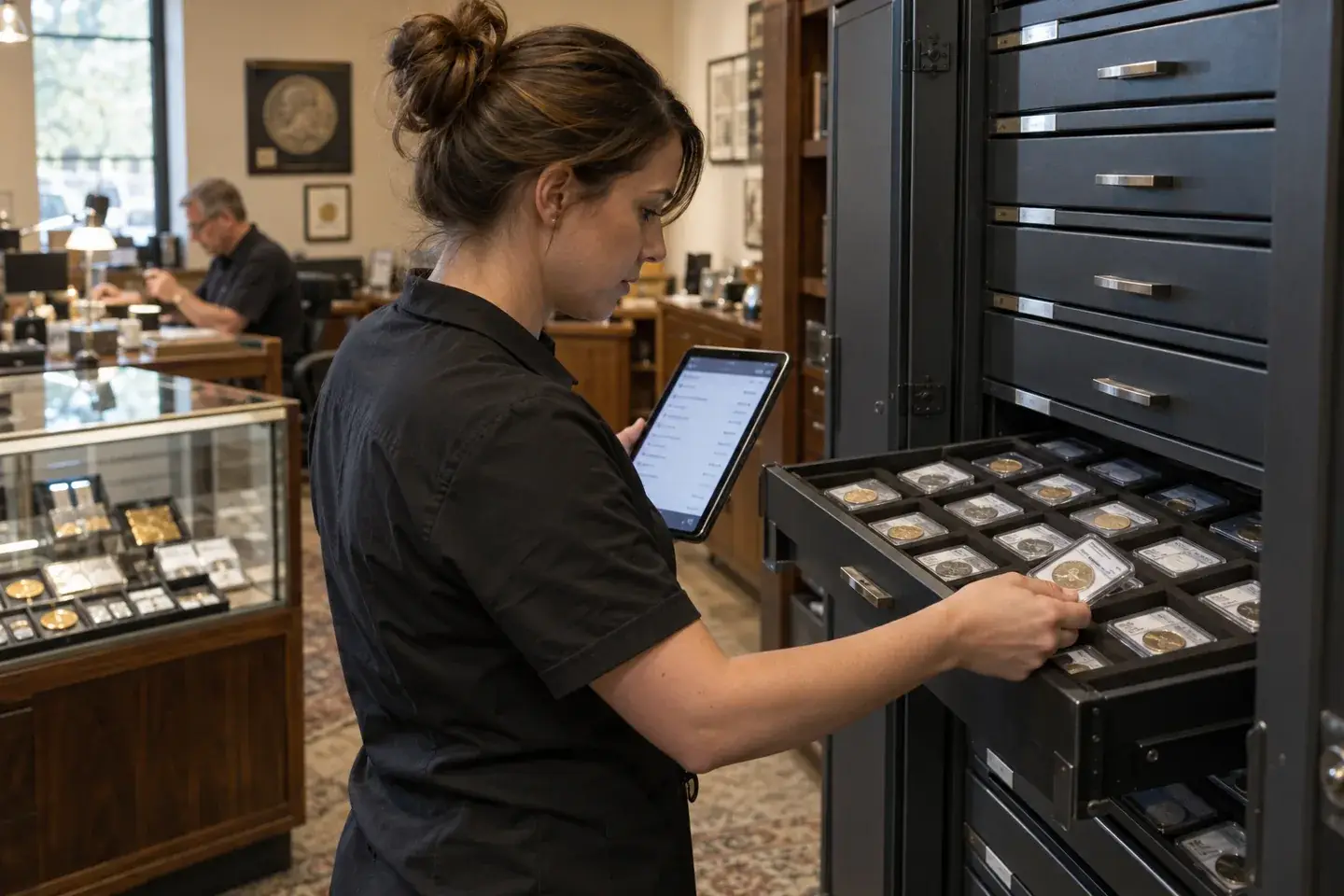
bullionOS connects purchased material to Cage Operations, a custody workflow for receiving, verification, movement, and release. Inventory remains the accounting quantity source of truth, while the Cage records answer operational questions: Where is this acquired lot? Who verified it? Did the measured quantity and weight match expectations? Why was it moved? Was an exception or approval required?
This separation is useful. Accounting inventory should not be distorted merely to represent which shelf or vault location holds an item. At the same time, a location note should not be mistaken for a financial ledger. Connecting the two creates a fuller record without forcing one number to perform every job.
Barcode scanning further closes the gap between screen and floor. Staff can use a barcode-oriented workflow to locate products or controlled items, reducing reliance on handwritten labels and tribal knowledge. For dealers with a growing catalog or multiple storage areas, faster retrieval also improves the client experience at the counter.
Use movement history before making adjustments
When a count looks wrong, the fastest response is often to type the “correct” number into the system. It is also one of the most dangerous habits in inventory management. A direct adjustment may hide the symptom while preserving the cause: a duplicate invoice, an unreleased reservation, a receiving variance, an incorrectly mapped product, or a transaction completed under the wrong status.

bullionOS records inventory movements so staff can investigate the path behind a count. The recommended operating practice is to begin with the affected product, invoice, and movement history. Determine whether the real-world event and the system record disagree. Then use the appropriate cancellation, release, correction, or authorized adjustment—with a reason—rather than overwriting history.
This produces a durable answer to “why.” Owners can distinguish ordinary transaction flow from manual intervention. Managers can spot repeated process failures. Staff can resolve the source instead of making a new unexplained number. Accounting can reconcile changes to the underlying invoices.
An audit trail is not useful only after a serious incident. Its everyday value is operational memory. It allows the dealership to learn without depending on who happens to be working that day.
Coordinate counter, online, and fulfillment channels
Inventory becomes more difficult when the same stock is visible in several sales channels. A product offered online may also be quoted by phone or sold at the counter. A web order can arrive while an employee is building an in-person transaction. Pickup and shipping introduce additional states between commitment and physical release.
The solution is not to maintain a separate “internet inventory” spreadsheet. It is to connect order events, invoices, reservations, fulfillment, and availability. In bullionOS, online order workflows can create or enrich the client record, create the appropriate invoice once, apply inventory handling, and move the order toward pickup or delivery. Signed and retry-safe order events help avoid creating duplicates when systems communicate more than once.
Channel visibility is also separate from whether a product is active internally. A dealer may want a product available for staff use without publishing it online. That separation gives the business control over merchandising while preserving a single product identity.
When every channel refers to the same availability logic, staff spend less time comparing systems and more time serving clients. Just as importantly, the owner can see commitments across the operation rather than receiving separate answers from the website, counter, and shipping desk.
Build a daily inventory discipline
Software works best when it supports a clear operating rhythm. A practical inventory discipline for a coin dealership can include:
At opening
- Confirm that live spot and critical pricing sources are healthy.
- Review unresolved inventory exceptions, pending Cage receipts, and missing locations.
- Review reserved orders, pickup-ready transactions, and shipments that require attention.
- Check that online availability and internal availability are not reporting unexplained differences.
During the day
- Start from the client or transaction record that caused the event.
- Search before creating a new product or client.
- Confirm product, quantity, pricing, payment, and client details before completing an invoice.
- Receive and verify purchased material through the controlled custody workflow.
- Use reservations for genuine commitments; release them promptly when commitments end.
- Investigate discrepancies through invoice and movement history.
At closing
- Reconcile buy and sell activity against the day’s transaction totals.
- Review open reservations, unpaid orders, pickup-ready items, and shipping handoffs.
- Confirm that Cage exceptions and requested releases have owners.
- Document or assign every unresolved discrepancy before staff leave.
This rhythm turns inventory management from a periodic cleanup project into a sequence of small, traceable decisions.
What connected inventory gives the owner
The owner’s question is rarely just “How many do we have?” The more useful questions are: How much capital is tied up? What is reserved? What is aging? Which material lacks a clear location or disposition? What is the current metal exposure? Which exceptions require approval? Are online commitments aligned with physical availability? Which products and clients drive profitable turnover?
Those questions can only be answered when product, price, transaction, client, custody, and accounting records share a common workflow. bullionOS is designed to make the underlying records available from operational summaries and drill-downs. A metric should lead to the transactions that support it, not end in a decorative dashboard.
The result is not merely a cleaner stock list. It is a dealership that can quote with greater confidence, protect client commitments, investigate discrepancies faster, and make capital decisions from current operating data.
Turn inventory into a controlled advantage
Precious-metals inventory will always require judgment. No software can grade a coin, choose every exit channel, or replace the physical discipline of experienced staff. But software can make sure that those judgments occur on top of reliable facts.
bullionOS connects the facts that coin dealers use every day: product specifications, live pricing rules, buy and sell invoices, on-hand and reserved quantity, weighted-average cost, Cage custody, barcode workflows, channel visibility, and movement history. It gives each real-world event a record and lets that record carry its effect across the business.
If your team is reconciling spreadsheets, website quantities, handwritten location notes, and invoice history to answer a basic inventory question, the process is already costing time and increasing risk. A connected inventory operating system gives the dealership one place to see what it owns, what it has promised, where it is, what it cost, and why it moved.
Ready to see the workflow with your own products and processes? Request a private bullionOS walkthrough at bullionos.co.