
Bullion Price-Lock Management: Quotes, Expiration, Exposure, and Exceptions
LEDGER · September 6, 2026

A lock is an operating commitment
A displayed price is information. A quote is an offer with stated assumptions. A price lock is the point at which the shop and customer become committed under the dealer’s terms. Confusing those states creates disputes and unmeasured exposure. Staff may believe a customer is merely considering a number while the customer believes the price is guaranteed; another employee may sell or offset inventory without knowing that a commitment already exists.
The workflow must name the state clearly and record the transition. Before acceptance, the price can be refreshed, revised, or allowed to expire. After acceptance, changes require a defined cancellation or exception process. The system should preserve the version accepted rather than replacing it with the current market value.
Price-lock policy belongs in customer terms, staff training, inventory rules, and accounting—not only in software. Work with qualified legal, tax, accounting, and market-risk advisers to define the shop’s commitments and any hedging or offset practices. The operational design described here focuses on making those decisions visible and repeatable.
Define the quote before calculating it
Start with the direction: the shop is selling to the customer or buying from the customer. Record product or item, metal, quantity, unit, fineness where relevant, reference spot source, spot timestamp, bid or ask side, premium or discount, fees included or excluded, taxes where applicable, delivery or payment assumptions, and quote expiration. For numismatic items, record the market basis and condition assumption rather than pretending the quote is a pure spot calculation.
Identify the authorized pricing rule. Routine products may inherit a matrix based on category, quantity, channel, and customer type. Manual prices should require a reason and, above a defined variance, approval. The user must be able to see whether the number came from a current rule, a manager override, or a stale reference.
Use decimal-safe calculations and consistent units. Ounces, grams, pennyweight, face value, and pieces should never be interchangeable by implication. Preserve intermediate inputs at sufficient precision and round the customer-facing amount according to documented policy. A price that cannot be reconstructed from its inputs is difficult to defend, reconcile, or improve.
Minimum lock record
- Customer, product, direction, quantity, and unit.
- Reference source, side, value, and timestamp.
- Premium, discount, fees, taxes, and total.
- Expiration, acceptance evidence, owner, and status.

Make expiration unambiguous
Every live quote needs a specific expiration timestamp and time zone. “Good for ten minutes” is useful only if the start time is fixed and both parties understand what must happen before the clock ends. Display the deadline prominently. Do not let a page continue showing an old number without an expired state.
Define acceptance precisely. Depending on the channel and terms, it may be a recorded verbal confirmation, signed document, authenticated click, payment action, or staff confirmation of an in-person agreement. Preserve who accepted, who recorded it, the time, and the exact quoted version. If the customer replies after expiration, create a refreshed quote; do not backdate acceptance.
Network delays, a frozen market, unavailable spot source, or rapid movement require prewritten rules. The system may shorten quote windows, pause new locks, require manager approval, or switch to manual confirmation. Staff should never invent the response while a customer waits. A visible “pricing unavailable” state is safer than a seemingly live price the shop cannot support.
Connect the lock to inventory
For a customer purchase, determine whether the quote is against specific on-hand units, a pooled quantity, supplier availability, or future procurement. A confirmed lock should reserve the appropriate quantity so another transaction cannot promise the same inventory. Reservation is not the same as physical movement; the item remains in its location but its available-to-sell state changes.
For a customer sale to the shop, the expected metal should enter an inbound position without becoming available inventory prematurely. The shop may have economic exposure before it has tested, received, or legally cleared the material. Keep expected, received, verified, held, and sellable quantities distinct.
Partial fills need an explicit rule. If a customer accepts ten units and only eight are available, the system should not quietly reduce quantity. Route the shortage for customer agreement, substitution, procurement, or cancellation under the dealer’s terms. Preserve the original commitment and the approved resolution.
Maintain one open-exposure view
Every accepted but unresolved lock should appear in a live position view. Group by metal and direction, but allow the manager to drill into the customer, product, quantity, reference price, current stage, promised settlement, inventory reservation, supplier order, and responsible employee. Include locks from the counter, phone, website, shows, and dealer-to-dealer channels.
Do not assume that an invoice, purchase order, or item in a tray automatically tells the exposure story. The economic commitment may begin before those documents are complete and may continue after a cancellation, failed payment, or delayed receipt. Define the event that opens exposure and the evidence that closes it.
Net summaries are helpful, but they can hide operational mismatches. A customer buy and customer sell may offset metal quantity while differing in product, timing, location, settlement, counterparty, or premium risk. Show gross commitments and the approved offsets underneath the net view. Managers need to see both the market position and the work required to complete it.
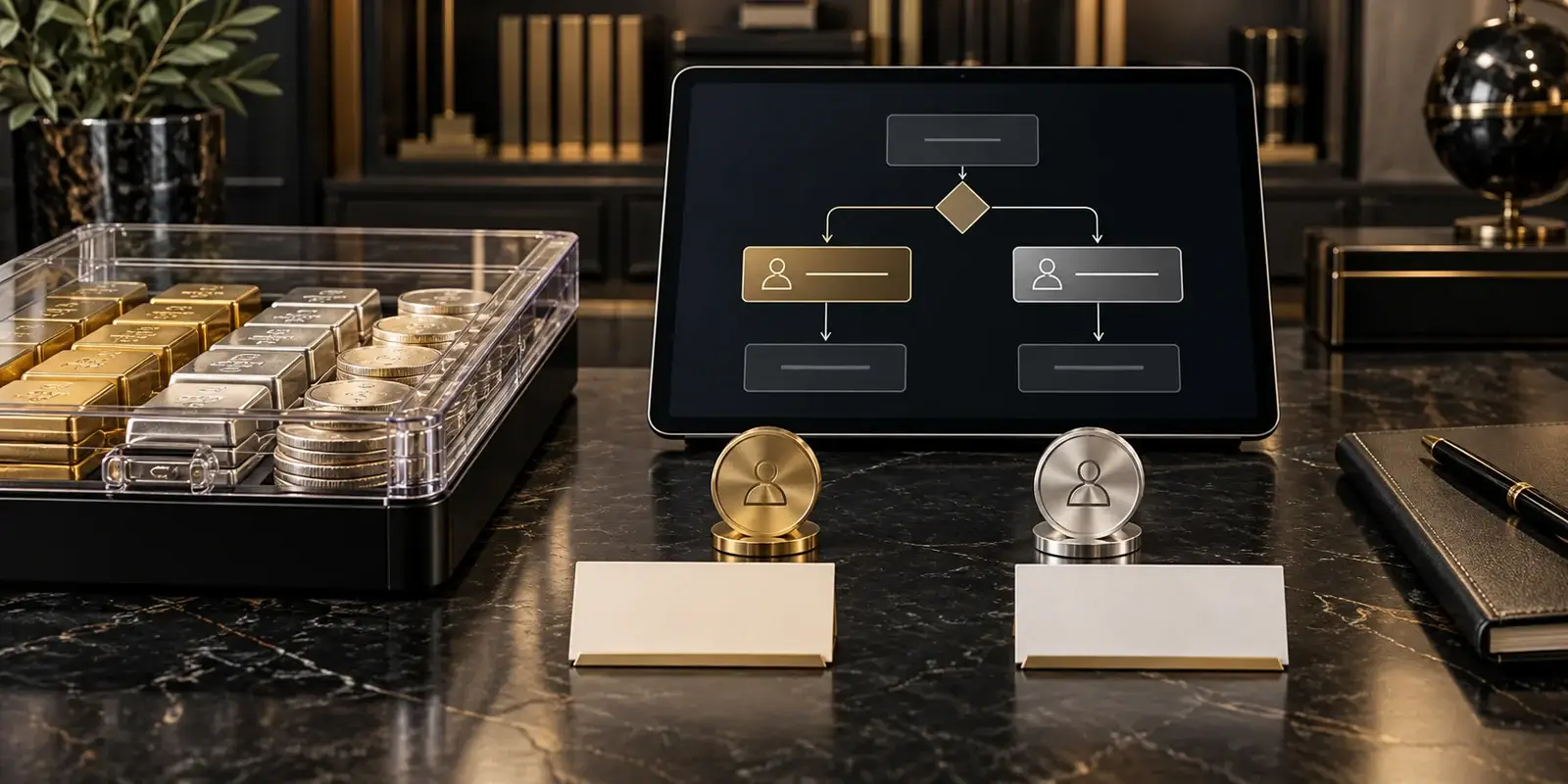
Record the approved offset or hedge
Dealers manage exposure in different ways: on-hand inventory, matched customer flow, supplier commitments, immediate wholesale transactions, or appropriately governed financial instruments. The method, authority, counterparty, limits, and accounting treatment must come from the dealer’s professional risk policy. Software should not guess that a position is covered because the net quantity happens to be small.
Link each offset to the locks or exposure pool it addresses. Record quantity, metal, side, price or reference, counterparty, time, fees, settlement date, and responsible user. Prevent the same offset from being applied twice. If offsets are pooled, preserve the allocation method so later profitability and reconciliation do not depend on memory.
An offset can introduce new risks: counterparty failure, basis difference, product mismatch, settlement timing, margin requirement, or operational error. Show those as open obligations rather than marking the transaction “done” at trade time. Reconcile counterparty confirmations and cash settlement independently. This article does not recommend any hedge or financial instrument; it describes the record needed after the dealer has chosen an authorized method.
Tie funding and fulfillment to the lock
Define payment expectations when the lock is accepted: method, deposit, deadline, cleared-funds requirement, identity or account match, and consequence of failure. The payment record should reference the lock and invoice directly. Staff should see whether funds are expected, initiated, received, cleared, failed, reversed, or refunded.
For outbound bullion, separate reserved, picked, verified, packed, shipped, delivered, and customer-collected states. For inbound metal, separate expected, arrived, tested, accepted, held, paid, and available. A lock should not close merely because an invoice was created. Close it when the dealer’s policy says economic, payment, and delivery obligations are resolved.
Settlement deadlines matter to exposure. An overdue wire, missing shipment, or uncollected order should appear in both customer operations and the position review. Assign an owner and next action. The pricing desk should not have to search the shipping system and bank portal to learn whether a commitment remains open.
Design exceptions before the market moves
Common exceptions include late acceptance, incorrect quantity, stale price source, manual premium error, inventory shortage, failed payment, delayed receipt, customer cancellation, staff error, duplicate lock, wrong metal or unit, and unavailable approver. Create reason codes that describe the event without replacing a factual note.
The first response is containment: prevent fulfillment, payment, resale, or offset changes that would compound the problem. Capture the original record, current reference value, related communications, physical status, and known financial effect. Route the case to someone with authority to honor, reprice, cancel, substitute, or negotiate under policy.
The approver should see the impact of each choice. What was promised? What is the current market difference? Is inventory reserved or an offset placed? Has money moved? Has the customer relied on the commitment? Which terms apply? Record the selected resolution and its reason. Do not solve an error by editing the original quote until it looks correct.

Treat cancellations as linked financial events
A cancellation does not delete the lock. It changes its status and may create additional events: release inventory, unwind or reassign an offset, cancel a supplier order, refund a payment, charge or waive an agreed fee, notify the customer, and recognize a gain or loss according to policy. Keep those events linked to the original commitment.
Use separate reasons for customer request, shop error, nonpayment, failed verification, unavailable product, duplicate order, fraud concern, force majeure, or mutual agreement. The reason affects the operational path and the review. Any fee or market-loss treatment should follow clear customer terms and applicable law, not an improvised calculation after the fact.
Require stronger approval when the cancellation has material market impact, departs from terms, refunds to a different method, or closes a lock that has an offset. Confirm that reserved inventory returns to the correct availability state and that expected inbound material no longer appears as future stock. The exception remains open until the economic and physical records agree.
Reconcile price locks every day
The daily review should compare accepted locks with invoices, purchases, inventory reservations, inbound expectations, offsets, payments, shipments, receipts, and cancellations. Flag locks with no owner, expired quotes marked live, accepted locks with no downstream document, fulfilled orders with open exposure, offsets without linked commitments, payments past deadline, negative availability, and manual price changes after acceptance.
Reconcile quantities by metal and product, then reconcile dollars. Explain realized margin as acquisition or sale spread, metal movement, product premium movement, direct costs, exception adjustments, and any authorized offset result. The exact accounting presentation belongs with the dealer’s accountant, but operations should supply complete, immutable events.
Use a close checklist with named sign-off. Small differences should not be silently netted across unrelated customers. Correct errors with linked reversals or adjustments that preserve the original event. Aging is critical: a small unresolved lock can become a large reconciliation problem after several days of market and operational activity.
Metrics that reveal control quality
Track quote-to-lock conversion, average acceptance time, expired-quote attempts, manual price overrides, approval turnaround, open exposure by age, locks without reservations or inbound records, payment failures, cancellations by reason, exception cost, fulfillment time, and unreconciled quantity or value. Segment by channel, location, employee, customer type, and product.
Interpret metrics together. A high conversion rate may come from weak margins. Very few exceptions may mean excellent operations or poor reporting. Short quote windows can reduce exposure but frustrate customers if staff cannot complete acceptance quickly. Set guardrails around margin, service, and control instead of optimizing a single number.
Review notable exceptions as process lessons. Was the interface unclear? Was a product rule stale? Did staff lack authority at the needed time? Did inventory availability lag reality? Adjust the rule, training, permission, or workflow. The purpose of the audit trail is not simply to assign fault; it is to keep the same failure from becoming standard practice.
A clean implementation sequence
- Define quote, lock, expiration, acceptance, cancellation, and closure in customer and staff terms.
- Document pricing sources, units, matrices, precision, manual-override limits, and outage behavior.
- Connect accepted locks to inventory reservations or inbound expectations and one exposure view.
- Link approved offsets, payments, fulfillment, and exceptions without overwriting original events.
- Launch daily reconciliation and weekly analysis of exceptions, margin, and timing.
When every accepted price has a clock, an owner, a position, and a closing event, the dealer can serve customers quickly without losing sight of the obligation underneath the quote.
Connect this workflow in bullionOS
Bring this operating process into one connected dealer record. Explore Bullion Dealer Software for Inventory & Pricing, or visit the bullionOS dealer operations resource hub for related guides.